
Why Measurement Deserves More Than A Sliver of Your Budget
- Sep 9, 2025
- 2 min read
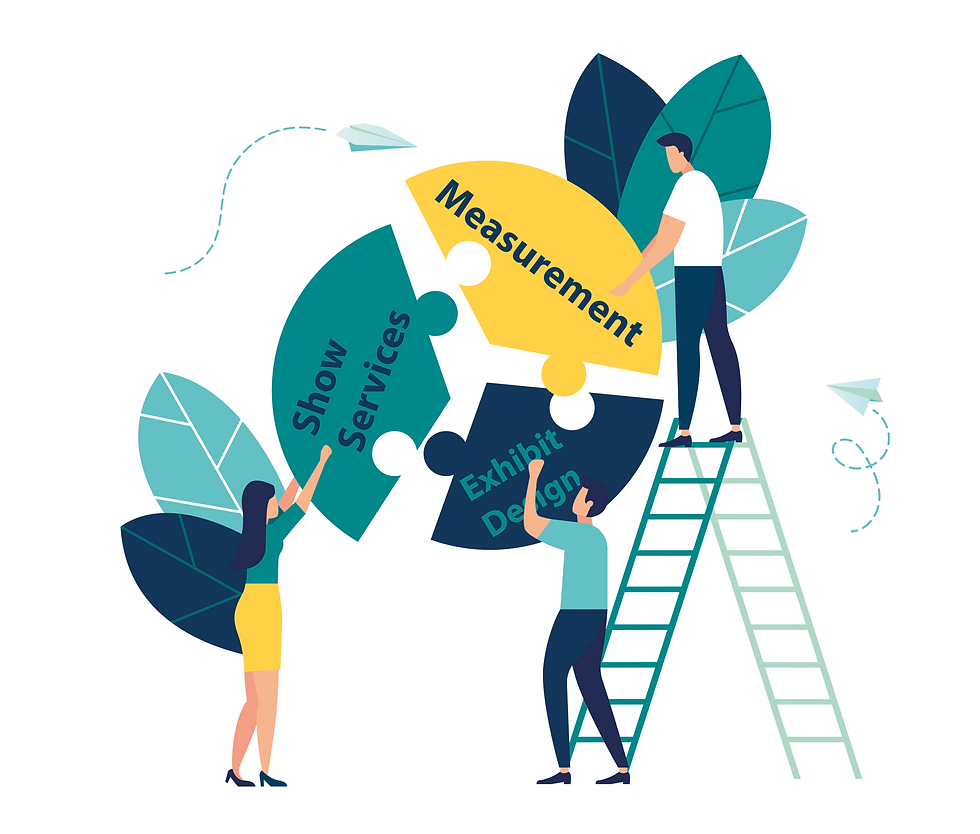
Measurement isn’t new. For decades, exhibitors have relied on lead counts or anecdotal feedback as proof of event success. That “old school” approach was simple but limited - reducing ROI to the number of badges scanned or business cards collected.
Today, measurement has evolved. With AI and advanced analytics, exhibitors can see how attendees move and engage throughout the booth and the show floor. Despite this, recent industry research revealed that measurement still accounts for just 2% of exhibitor budgets. Shipping, storage, travel, and show services often consume 8-18% each. Still, those line items don’t answer the most important question: What impact did our investment actually have on awareness, engagement, and business outcomes?
Why Measurement Punches Above Its Weight
Budgets naturally flow to the visible and tangible - booth design, build, logistics and staffing. Measurement, however, often ends up as one of the smallest allocations.
That doesn’t mean exhibitors don’t value results – it often reflects habit or the assumption that lead counts and anecdotal feedback are “good enough.” But with today’s tools, measurement can deliver far more – even protecting those larger investments.
The irony is that, despite being small, measurement spend offers one of the highest returns per dollar invested. It provides answers to questions exhibitors can’t afford to leave unanswered, such as:
Was the booth in an optimal position on the exhibit floor?
How many visitors engaged meaningfully versus just stepping into the space?
Which areas of the booth were most effective - and which were underutilized?
How can we use this year’s insights to make next year’s strategy even more effective?
The Real Cost of Minimal Measurement
When measurement is treated as an afterthought or remains underfunded, exhibitors risk:
Making design and staffing decisions based on assumptions instead of data
Missing opportunities to refine booth layouts to maximize engagement
Identifying underperforming displays before repeating them at future shows
Losing executive trust when budgets are questioned and cuts loom
In other words, the risk isn’t overspending on measurement - it’s underestimating its role in driving smarter, more effective strategies.
From “Nice-to-Have” to Essential
Measurement shouldn’t be treated as optional. It’s the backbone of a strong event strategy. Even a modest allocation in the right tools can deliver unbiased insights that validate spend, guide smarter decisions and demonstrate the full value of your event investment.
Not all measurements are equal. Traditional methods like badge scans or post-show surveys offer only partial snapshots. They tell you who stopped by, but not how visitors moved, engaged or responded to different elements of the booth. These approaches can be helpful, but they leave major blind spots and introduce bias - shaping results around what teams hope to see or selectively highlighting favorable outcomes.
AI-powered analytics, by contrast, consistently provides a more complete and accurate picture. They capture the full attendee journey - from impressions and walk-bys to in-booth dwell time and engagement with specific activations. This level of detail doesn’t just prove ROI, it helps exhibitors understand what worked, what didn’t and how to evolve strategies for future success.
In other words, the most important investment isn’t necessarily more dollars - it’s about investing those dollars toward tools that can truly inform decisions and protect the much larger spend on booth space, design and logistics.


Comments